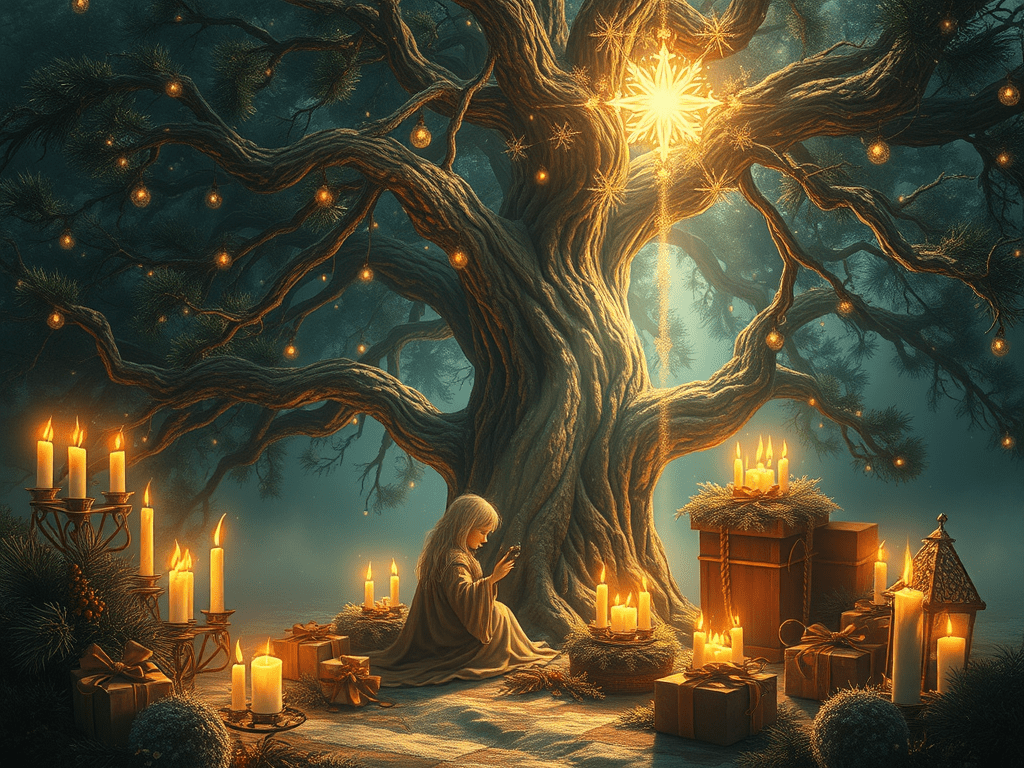
Christmas has never really been about a single historical moment.
From a shamanic perspective, it’s about cosmic timing. It involves renewal and the rebirth of light. This is a threshold humans have marked for tens of thousands of years. Long before Christianity, cultures around the world took a pause at this exact point in the year. The land, the sun, and the human nervous system demanded it.
This season isn’t symbolic by accident. It’s biological, ancestral, and energetic.
Midwinter: The Death-and-Rebirth Point
Christmas arrives just after the winter solstice, when darkness reaches its peak and the sun begins its slow return. In shamanic traditions, this moment is understood as a death-and-rebirth threshold.
The old cycle has fully ended.
The new life force is fragile—but undeniably present.
Light is born from within the dark.
This is why so many cultures tell nearly identical stories at this time of year. They speak of a solar child and a divine infant. There is also mention of a sacred spark born when the world seems coldest and most hopeless. This isn’t metaphor. It’s an energetic reality. Something shifts in the natural world—and in us.
The Sacred Child Within
In shamanic psychology, the “child” archetype represents pure potential. It is the soul before conditioning, before fragmentation, before survival strategies took over.
The birth of the sacred child at midwinter symbolizes the renewal of your own inner spirit. No matter how much this year has taken from you, something essential in you survived. You’ve endured loss, challenges, and growth. Christmas reminds us of that truth.
Evergreens, Trees, and Protective Spirits
Evergreen trees were central to ancient winter rites for practical and spiritual reasons. They remain alive when everything else appears dead. They symbolized continuity, endurance, and protection.
Shamanically, trees represent the World Tree—the axis connecting the underworld, the human world, and the spirit world. Evergreens were believed to house ancestral and guardian spirits.
Bringing a tree indoors was never decoration. It was an ancient protective act. This act invited life force and spiritual guardians into the home. This occurred during the most vulnerable time of year.
Gift-Giving as Energy Exchange
In early cultures, gifts weren’t about material value. They were offerings. Acts of reciprocity. Ways to keep energy moving when stagnation meant danger.
Winter was a time when hoarding—whether food, warmth, or emotional connection—could be deadly. Sharing maintained balance. It kept the tribe alive.
Even today, giving during this season restores flow. It reminds us that survival has always been collective.
Fire, Light, and Feasting as Survival Magic
Candles, hearth fires, and communal meals weren’t indulgences. They were ritual survival magic.
Fire symbolically called the sun back.
Light protected against wandering spirits.
Feasting strengthened bonds when isolation threatened both body and soul.
This is why Christmas often feels emotionally heavy. These rituals activate deep ancestral memory. Your nervous system remembers winters when survival wasn’t guaranteed.
The Thin Veil Between Worlds
Midwinter was widely seen as a time when the boundary between worlds grew thin. Ancestors were believed to draw close. Spirits wandered freely. Dreams carried messages.
That strange mix of nostalgia, sadness, and longing people feel around Christmas isn’t random. It’s a veil-thinning response. You don’t just miss people—you miss past versions of yourself, lost timelines, unrealized futures.
Santa Claus: The Winter Shaman in Disguise
Even Santa isn’t a modern invention.
Beneath the commercial image is a syncretized shaman figure—part Siberian, part Norse, part folk memory, later Christianized through Saint Nicholas.
Among Arctic and Siberian cultures:
- Shamans wore red-and-white garments
- They worked with Amanita muscaria mushrooms (red with white spots)
- Mushrooms were dried in evergreen trees
- Winter snow blocked doors, so shamans entered homes through roof holes
- Midwinter ceremonies involved bringing medicine, blessings, and protection
The red suit.
The chimney.
The reindeer.
The sack of gifts.
These aren’t coincidences. Santa is a winter shaman. He is a guide who moves between worlds to deliver protection and hope. He does this when the tribe needs it most.
Saint Nicholas didn’t erase this figure. He softened and reshaped it. Old spirits survive by wearing new costumes.
Why Christmas Brings Grief and Joy at the Same Time
If Christmas feels emotionally intense for you, nothing is wrong with you.
This season is a seasonal initiation.
Biologically, light scarcity lowers serotonin and turns attention inward. The body remembers ancestral winters when survival was uncertain. Emotionally, unresolved grief surfaces.
At the same time, the sun has turned. Something is coming back. Hope becomes biologically and psychologically possible again.
So the psyche holds contrast:
- What was lost
- What might still be possible
That overlap is intense because it’s meant to be.
Shamanically, ancestors are close during this time. Modern culture tells us to be cheerful, grateful, festive. Ancient cultures said something very different: sit with the dead, cry honestly, then feast.
When grief isn’t honored, it leaks out as irritability, numbness, or sudden sadness during “happy” moments. This isn’t weakness—it’s suppressed ritual.
The Deeper Pattern
Santa is the guide through darkness.
Christmas is the crossing point.
Grief and joy overlap because death and rebirth are happening at once.
In shamanic terms, this season asks us to:
- Let something die honestly
- Carry the surviving spark forward
- Be seen in both sorrow and hope
The problem isn’t that Christmas brings mixed emotions.
The problem is pretending it shouldn’t.
Closing Reflection
Whether you’re religious or not, this season works on you. It’s older than belief systems. It’s written into the sun, the land, and the nervous system.
If you feel tender, quiet, heavy, or strangely hopeful—let yourself feel it. Honor what was lost. Protect what survived. Carry the light ahead.
That’s the real meaning of Christmas.
 Shamanic Healing