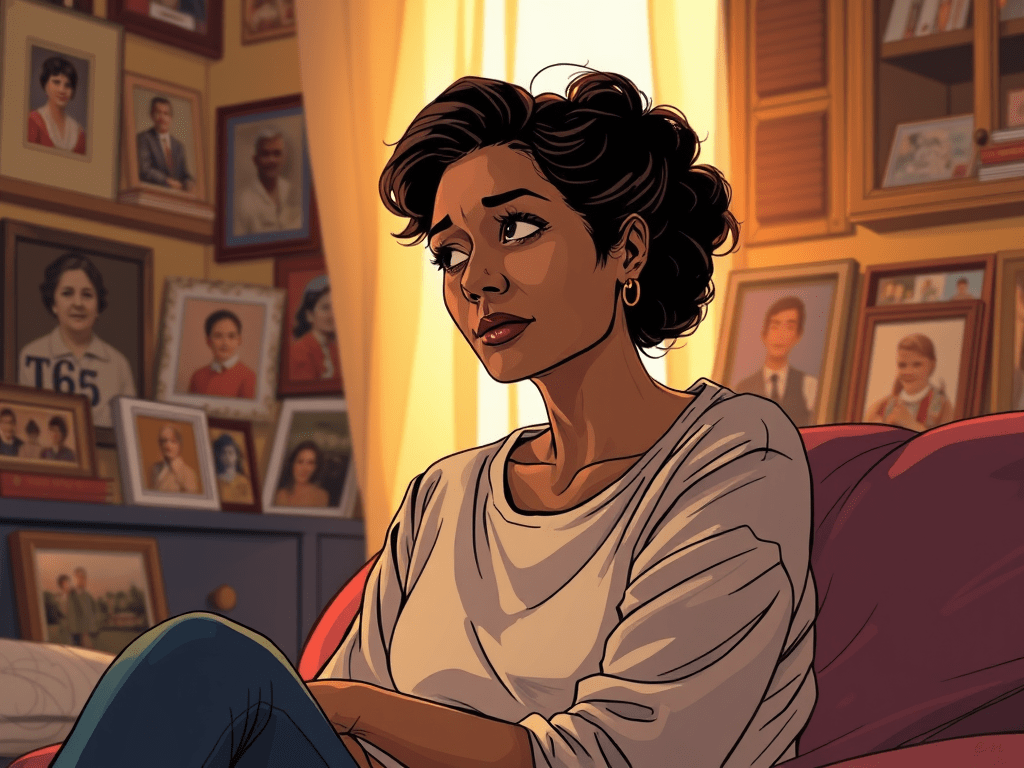
I’ve been reflecting recently on how rarely low self-worth appears randomly in a person’s life.
Very often it is learned, modeled, and quietly reinforced across generations.
Women taught to shrink their voice.
Women taught to endure rather than speak.
Women taught that survival mattered more than self-expression.
These messages were rarely delivered as direct instructions. More often they were absorbed through observation — through how the women before us navigated relationships, responsibility, and safety.
A grandmother who kept peace at any cost.
A mother who carried emotional weight without support.
A lineage where strength meant endurance rather than visibility.
Over time these messages become more than beliefs.
They become patterns in the nervous system.
Ways of responding, relating, and moving through the world that begin to feel almost automatic.
A woman may notice she hesitates before expressing an opinion.
She may minimise her needs in relationships.
She may find herself working harder than necessary to earn approval or stability.
Often these patterns appear quietly in areas like relationships, money, health, or self-perception.
And because they are so familiar, they can feel deeply personal — as if they belong entirely to us.
But very often the roots reach further back.
Many emotional patterns did not begin with the person carrying them today. They developed in environments where silence ensured safety. Self-sacrifice maintained belonging. Survival left little space for individual expression.
These adaptations were not weaknesses.
They were intelligent responses to the circumstances of the time.
In many families, women carried extraordinary responsibility with very limited resources or freedom. Endurance became a form of stability. Self-silencing became a way to maintain connection.
The nervous system learns these patterns not through theory, but through repetition.
A pattern reinforced across multiple generations can start feeling almost structural. It can seem as though this pattern is simply part of who someone is.
However, patterns that once supported survival can continue operating long after the original conditions have changed.
A woman may now have far more freedom, safety, or opportunity than the women before her. However, she might still feel an internal restriction. This restriction is not easily explained.
This is often where generational healing becomes relevant.
Not as a dramatic rewriting of the past. Instead, it is a careful process of identifying where inherited emotional patterns are still shaping the present.
When someone starts to examine a pattern of inherited shame, she is not rejecting the women who came before her. This also applies to examining chronic self-doubt or self-diminishment.
She is creating space for the lineage to evolve.
Healing in this context is not about blaming the past.
It is about understanding what was carried forward, and deciding consciously what remains necessary.
When a pattern has existed for decades, it is finally brought into awareness. The nervous system then gets an opportunity to reorganise.
What once felt automatic can become optional.
What once felt like identity can become recognised as inheritance.
And once something is recognised, it can be approached differently.
Sometimes when one person does this work, something shifts quietly across the family line.
The weight becomes lighter.
The choices become wider.
The next generation begins from a different foundation.
This kind of healing is rarely dramatic.
This work is careful and structured. It involves tracing patterns to their origin. The nervous system is then allowed to release what is no longer needed.
Often the change is subtle at first.
A woman speaks more clearly in a conversation.
She notices a familiar self-critical thought and does not follow it.
She sets a boundary without the same level of guilt.
Small shifts like these are often the first signs that a long-standing pattern is loosening.
Over time, they accumulate.
And gradually the way a person moves through the world begins to change.
Not because she forced herself to become someone different.
But because something that was never truly hers to carry has finally been set down.
Some women recognize a pattern in their life. They believe it may have deeper generational roots. This work can be approached in a focused and structured way.
I offer a private generational healing container. It consists of five sessions. These sessions are designed to trace inherited emotional or physical patterns back to their origin. This allows them to be cleared at the source.
The container is intentionally limited and held within a calm, contained process.
It is designed for women who are ready to address patterns at their root. They do not want to continue working only at the surface.
 Shamanic Healing