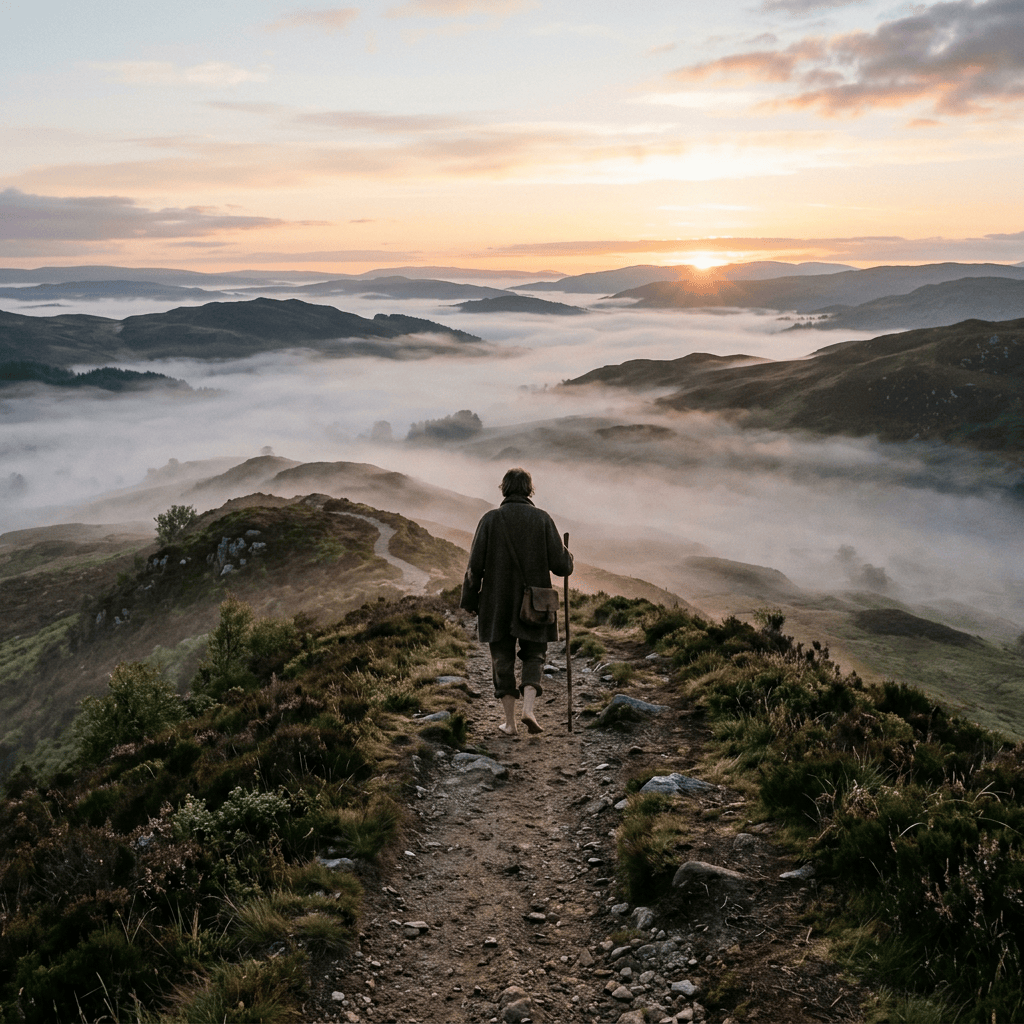
“Perhaps the greatest shift isn’t happening in the world around us… but in the way we experience it.”
For years, I heard people speak about the transition from 3D to 5D consciousness.
At first, I dismissed it.
It sounded abstract, mystical—almost impossible to define.
But over time, I realised something important.
Whether or not you use the language of 3D and 5D is almost irrelevant.
What matters is the experience.
And many of us are undeniably living through one.
An Ancient Memory
Long before anyone spoke of “dimensions” or “consciousness shifts,” ancient cultures were already telling us this story.
The Maya tracked time not as a straight line, but as a series of great cycles—ages that end so that new ones can begin. Their Long Count calendar marked the close of one such cycle in December 2012, a date that was widely, and often inaccurately, reported in popular culture as a prophecy of apocalypse. That was never what it meant to the Maya themselves. To them, it marked the end of a cycle and the beginning of another—a turning point, not an ending.
The Andean peoples speak of something similar: Pachakuti, a world-reversal, a time when what has been upside down turns right-side up again.
The Hopi speak of a choice between two paths at the threshold of change—one of chaos, one of harmony.
Across Siberia, the Amazon, Africa, and Aboriginal Australia, shamanic lineages that never had contact with one another arrived at strikingly similar understandings: that humanity moves through ages, that certain thresholds ask something of us, and that the deepest crises are also invitations.
I want to be honest with you here. I’m not a historian, and I’m not going to claim these traditions predicted a literal, scientifically measurable shift in human consciousness. That isn’t something I can prove, and I don’t think it needs to be true in that sense for it to matter.
What I do believe is this: these traditions were not naive. They were built by people who watched the sky for thousands of years, who studied human nature across generations, and who noticed something worth passing down—that civilisations rise, forget themselves, and eventually have to choose whether to remember who they are or continue forgetting.
Maybe we’re not living through a mystical dimensional shift.
Maybe we’re living through something the old ones simply had a better word for than we do.
Living in 3D
When people speak about 3D consciousness, they’re rarely talking about physical dimensions.
They’re describing a way of living.
- A life dominated by fear.
- Competition.
- Scarcity.
- Control.
- Constant comparison.
- Always needing to be right.
- Always needing more.
- Always believing happiness exists somewhere in the future.
- It is a state of perpetual survival.
Ironically, modern neuroscience shows us something remarkably similar to what the old traditions described in their own language.
When we’re under chronic stress, our nervous system spends more time in survival mode. The brain prioritises detecting threats over creativity, connection, and long-term thinking. Stress hormones such as cortisol are helpful in short bursts, but when they remain elevated, they can narrow our attention, increase anxiety, and make it harder to regulate our emotions.
In other words…
A survival state doesn’t just affect how we feel.
It changes how we perceive reality itself.
Perhaps this is what the shamans meant when they spoke of a “lower” or denser way of being. Not a literal dimension. A narrowed one.
The Illusion of Constant Crisis
Never in history have we had access to so much information.
Within minutes, we can know about:
wars…
animal cruelty…
political conflict…
natural disasters…
economic uncertainty…
suffering occurring on the other side of the planet.
While awareness is important, our nervous systems were never designed to absorb the suffering of millions of people every single day.
The result?
We begin carrying grief that isn’t ours to carry.
We feel guilty for enjoying a peaceful walk because somewhere else, tragedy is unfolding.
We become emotionally exhausted by events we have no ability to influence directly.
This doesn’t make us more compassionate.
Often…
It simply makes us more overwhelmed.
The old traditions warned about this too, in their own way. Many shamanic cultures held strict practices around what a person should and shouldn’t carry—rituals for releasing grief that wasn’t theirs, ceremonies for closing the day’s burdens before sleep. They understood something we’ve forgotten: that the human spirit was never built to hold the weight of the whole world at once.
Presence Is Not Ignorance
Choosing presence does not mean pretending suffering doesn’t exist.
It means recognising where your energy can genuinely make a difference.
If your neighbour is lonely…
Be present.
If an elderly person needs help carrying shopping…
Help them.
If a child needs encouragement…
Encourage them.
If an injured animal crosses your path…
Care for it.
If your own family needs more of your attention…
Give it.
Compassion begins where your hands can reach.
The ripple created by genuine human connection often travels much further than endless outrage on a screen.
The Prophecy of Forgetting
There’s a thread that runs through so many of these old traditions, and it isn’t really about the end of the world.
It’s about forgetting.
The Maya, the Hopi, the Andean lineages, the shamans of Siberia and the Amazon—so many of them describe the same core pattern. Humanity grows powerful. Humanity grows disconnected from the earth, from spirit, from each other, from itself. And that disconnection eventually becomes unsustainable. Something has to give.
Some traditions call this a purification. Others call it a reckoning. Others simply call it a return.
Whatever word you use, the pattern is the same: forgetting is followed by a choice. Continue forgetting, or remember.
I don’t think we need ancient prophecy to see this happening. Look around. Record rates of anxiety and burnout. Record disconnection from nature, from community, from our own bodies. A world of more comfort than any generation before us, and yet so much quiet suffering.
Maybe the old predictions weren’t fortune-telling.
Maybe they were pattern recognition, passed down so we wouldn’t have to learn it the hard way.
We’re learning it the hard way anyway.
Returning to Mother Earth
One of the greatest losses of modern life is not technology.
It is disconnection.
For thousands of years, our ancestors lived in relationship with the natural world.
They watched the sunrise.
They understood the seasons.
They knew the names of birds.
They recognised animal tracks.
They gathered around fire.
Nature wasn’t somewhere they visited.
It was home.
Shamanic traditions across Siberia, South America, North America, Africa, Australia, and Europe all share one profound understanding, even though they developed independently of one another across thousands of miles and thousands of years:
Human beings are not separate from nature.
We are part of it.
Modern research is beginning to echo this ancient wisdom. Studies suggest that spending time in natural environments can reduce stress, improve mood, restore attention, and support emotional well-being. Time outdoors has been associated with lower blood pressure, calmer nervous system activity, and improved psychological health.
Perhaps our ancestors didn’t need scientific studies.
They simply remembered what we have forgotten.
What It Means to Be Human
Underneath all of this is a question I think most of us are quietly asking, even if we never say it out loud.
What does it actually mean to be human?
Not a job title. Not a role. Not a set of achievements or possessions or a carefully curated version of ourselves built to be acceptable to everyone else.
Before all of that, we were creatures of instinct and wonder. We felt the cold and sought the fire. We felt grief and let ourselves wail. We felt joy and danced without self-consciousness. We looked at the stars and felt small and enormous at the same time.
Somewhere along the way, many of us traded that aliveness for safety. We learned to perform instead of feel. To achieve instead of experience. To armour ourselves instead of stay open.
It kept us safe.
It also slowly disconnected us from the very thing that makes life worth living.
I believe the necessity of our time isn’t to become more advanced, more optimised, more impressive versions of ourselves.
It’s to become more human.
More able to feel without needing to fix.
More able to rest without guilt.
More able to grieve without shame.
More able to love without armour.
More able to sit in silence without needing to escape it.
This is not weakness. It is the opposite. It takes tremendous courage to stay soft in a world that constantly asks us to harden.
Presence Is a Spiritual Practice
Many people believe awakening involves extraordinary experiences.
Visions.
Mystical encounters.
Hidden knowledge.
Perhaps.
But I have come to believe something much simpler.
Awakening begins the moment you fully experience this one.
The warmth of the sun on your skin.
The rhythm of your breath.
The sound of waves reaching the shore.
The smell of rain.
The laughter of someone you love.
The silence between thoughts.
Life has always been happening here.
We were simply somewhere else.
Returning to Yourself
When I found the shamanic path, I wasn’t searching for another belief system.
I was searching for myself.
Through ceremony, nature, stillness, and deep inner work, I slowly rediscovered parts of myself I thought had disappeared.
My humour.
My confidence.
My curiosity.
My sense of adventure.
My purpose.
I didn’t become someone new.
I became more fully myself.
That, to me, is what “5D” means.
Not escaping Earth.
Not transcending humanity.
But becoming deeply present within it.
Living with greater awareness.
Greater compassion.
Greater responsibility.
Greater connection.
Perhaps this is what the old cycles were always pointing toward. Not an external transformation of the world, but an internal one—a mass remembering, one person at a time, of what it actually means to be alive.
The Invitation
Perhaps the greatest revolution of our time isn’t technological.
Perhaps it’s remembering how to be human.
To slow down.
To listen.
To care.
To notice.
To reconnect—with the earth beneath our feet, the people beside us, and the quiet wisdom within ourselves.
Because maybe the journey from 3D to 5D isn’t about travelling to another dimension at all.
Maybe it’s about finally coming home.
The Return™
Return to yourself. Return to nature. Return to what has always mattered.

